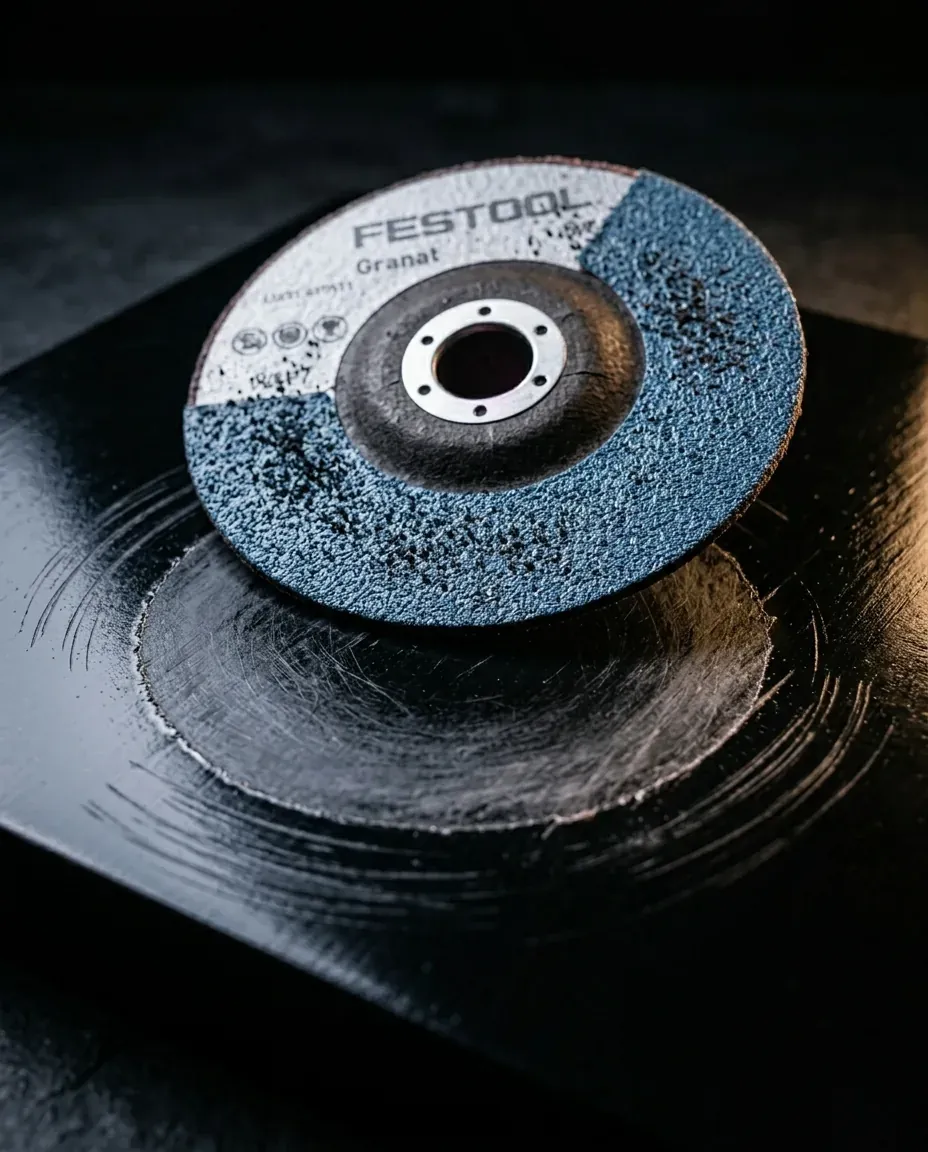
Discs
Pro
Grit · 100
Festool Granat 5-Inch Disc, 100 Grit (25-pack)
The pass that decides whether the surface is ready. Granat makes it count.
FEPA P-grade · Converted
P100 paper averages about 162 µm on the FEPA table. On the US CAMI scale that is between CAMI 80 and 100. A sheet printed plain "100" is a different animal: about 140 µm, nearer P100–P120. If the instructions say P100 and the pack has no P on it, reach for the CAMI number, not the digits.
What P100 is for
Clearing the 80 scratch; smoothing softwoods.
Either side of P100
At this grade
The pass that decides whether the surface is ready. Granat makes it count.
Questions people ask
It falls between CAMI 80 and CAMI 100. P100 averages 162 microns, and no CAMI grade lands within 10% of that.
About 162 microns average particle diameter, per the FEPA P-grade table (ISO 6344).
No. P100 averages 162 microns; a sheet printed plain "100" on the CAMI scale averages 140, which is closer to P100–P120. The CAMI sheet is the finer of the two.
Convert any other grade, from CAMI, microns or a Trizact A-number, on the grit converter.
Sizes are average particle diameters from the published FEPA (ISO 6344) and CAMI (ANSI B74.12/B74.18) tables. "Nearest" means within 10%; otherwise both neighbors are shown. Trizact pairings are 3M's own. Sources: Wikipedia, "Sandpaper" grit table (rev. 1127917881); Klingspor coated abrasives grit chart.